Golden Sugar is non-centrifugal cane sugar: it is made without refining or bleaching, so it keeps the film of molasses that coats every crystal, along with minerals (potassium, calcium, magnesium, trace iron) and antioxidant polyphenols such as caffeic acid and gallic acid. In NOVAFIT gels it is one of the five carbohydrate sources and provides sucrose—glucose and fructose in a 1:1 ratio—with a more complete profile than refined white sugar.
What Golden Sugar is and why it is not "just sugar"
Golden Sugar is cane sugar that has gone through the least possible processing between the field and the package. It is not centrifuged to separate the molasses from the crystals, not bleached, not refined. The result is a sugar with a golden-amber color, a slightly caramelized flavor and, above all, a different composition from conventional white sugar.
Structurally it is still mostly sucrose—glucose and fructose in a 1:1 ratio—but it keeps the film of molasses that coats every crystal. That film is where the difference lies: it contains minerals (potassium, calcium, magnesium, trace iron), organic acids and phenolic compounds with documented antioxidant activity, such as caffeic acid and gallic acid.
A study published in Food Chemistry (ScienceDirect, 2020) on non-centrifugal sugars—the category Golden Sugar belongs to—found caffeic acid concentrations of up to 313 mg/100g and gallic acid of up to 508 mg/100g in high-quality samples, with antioxidant properties comparable to those of benchmark products on the market.
The extraction process: from cane to golden crystal
Step 1 — Manual or selective harvest

The cane (Saccharum officinarum) is cut at its optimal point of ripeness, when the sucrose concentration in the stalks reaches its peak. The cut cane must be processed within hours: sucrose begins to degrade enzymatically as soon as the stalk is separated from the root. In artisanal Golden Sugar production, this means the supply chain has to be short and local.
Step 2 — Washing
The stalks are washed with clean water to remove soil, leaves and external debris. No chemical additives.
Step 3 — Milling and extraction of the cane juice
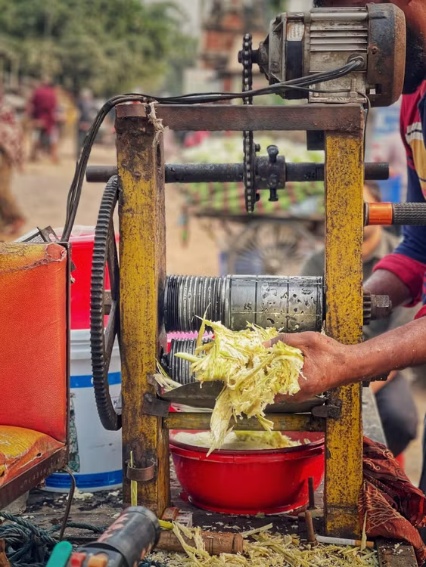
The stalks pass through rollers or presses that crush them and extract the raw juice—the guarapo—greenish-yellow in color with a sucrose concentration of between 10 and 15%. The solid residue (bagasse) is used as fuel to power the process itself: an almost closed energy loop.
Step 4 — Natural clarification
The cane juice is heated and a small amount of lime (calcium hydroxide) is added to precipitate the colloidal impurities. In the artisanal process without centrifugation, additional chemical clarifiers are avoided. The impurities float to the top and are removed by hand.
Step 5 — Gradual evaporation
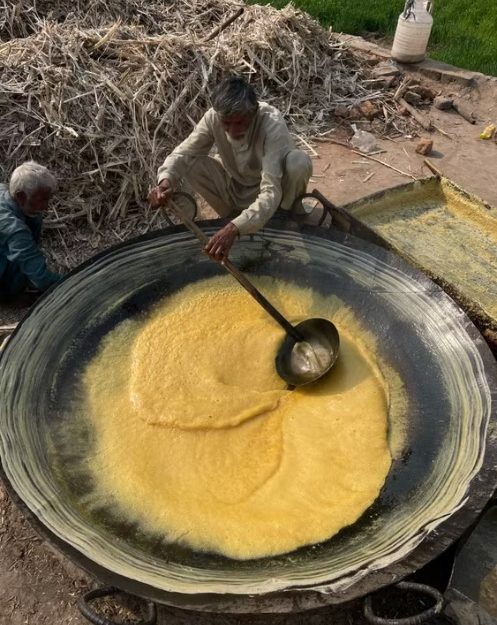
The clarified juice is transferred to large kettles where the water evaporates slowly—sometimes over hours—until it becomes a thick syrup with a sugar concentration of 60-70%. This is the most critical moment: excessive heat would destroy the phenolic compounds we want to preserve. The artisanal temperature control—done in an automated, aggressive way in industrial plants—is handled here with experience and patience.
Step 6 — Crystallization without centrifugation
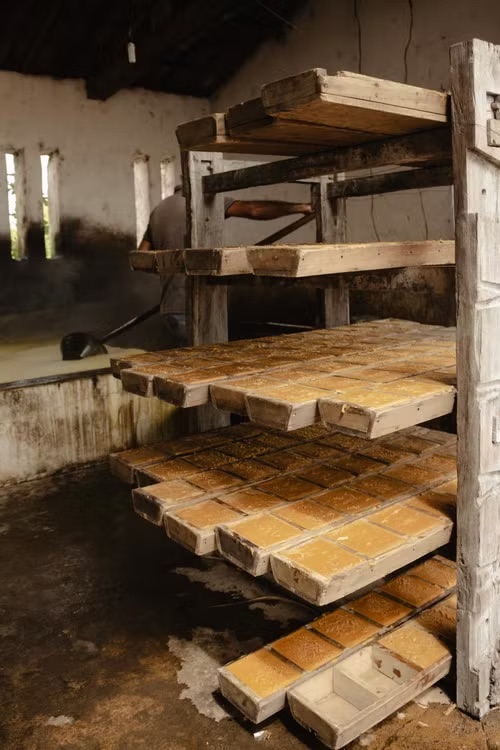
The syrup is left to cool in molds or crystallizers. The sucrose crystallizes progressively around natural nuclei. Because it is not centrifuged to separate the crystals from the molasses—as the white-sugar industry does—the crystals stay coated in that fine golden film. That coating is the difference between Golden Sugar and refined sugar.
Step 7 — Drying and packaging
The crystals are gently dried with warm air until they reach the right moisture level for storage. The result is a coarse-crystal, amber-colored sugar with that faint caramel aroma that sets NOVAFIT gels apart from any laboratory alternative.
Golden sugar vs white sugar: the table that says it all
| Characteristic | Refined white sugar | Golden Sugar (non-centrifugal) |
|---|---|---|
| Process | Extraction + centrifugation + bleaching + refining | Extraction + evaporation + natural crystallization |
| Color | White | Golden-amber |
| Main composition | Sucrose >99.9% | Sucrose + traces of molasses |
| Minerals | Practically none | Potassium, calcium, magnesium, iron (traces) |
| Phenolic compounds | Absent | Caffeic acid, gallic acid, flavonoids |
| Antioxidant activity | None | Documented (DPPH scavenging) |
| Flavor profile | Neutral sweetness | Sweetness with a complex caramel note |
| Gastrointestinal tolerance | Standard | Studies suggest a lower glycemic impact through the action of polyphenols |
| Compatibility with the 1:0.8 ratio | Yes (sucrose = glucose + fructose 1:1) | Yes, identical metabolic base |
| Additives in the process | Bleaching agents, flocculants | Lime (Ca(OH)₂) and water |
| Artisanal footprint | None | High — short process, local chain |
Note: the differences in micronutrients are real but modest in absolute terms. Golden Sugar is not a mineral supplement but an energy ingredient with a superior qualitative profile. In the context of a gel with 400 mg of sodium and 125 mg of magnesium, the mineral contribution of Golden Sugar is complementary and consistent with the formulation as a whole.
What this means in your NOVAFIT gel
In NOVAFIT gels, Golden Sugar is one of the five carbohydrate sources that make up the 45 g of CHO per gel. Together with glucose syrup, fructose syrup, maltodextrin and isomaltulose (Palatinosa™), it is part of a system designed to maximize intestinal absorption through the two independent transporters SGLT1 (glucose/maltodextrin) and GLUT5 (fructose).
Golden Sugar provides sucrose—which the intestine hydrolyzes into glucose and fructose in a 1:1 ratio—contributing to the overall 1:0.8 ratio that allows the body to absorb up to 90 g of carbohydrate per hour, according to Jeukendrup's studies (2008, 2017). But it provides something more: the film of molasses with its natural polyphenols, which some studies suggest may slightly slow glucose absorption in the intestine, smoothing the glycemic peak without penalizing total energy availability. For the endurance athlete, this translates into steadier energy and a lower risk of an abrupt crash.
And then there is the taste. In 10-hour ultras, when you have taken your fourth gel and your stomach starts to protest, the difference between a gel that tastes like industrial syrup and one that tastes like real fruit with a gently sweet finish can decide whether you keep eating. Golden Sugar is part of that difference.
Nutritional takeaway: what Golden Sugar means for you
Golden Sugar in a sports gel formulation is not marketing. It is a choice with real consequences.
For any endurance athlete it means a supply of high-purity sucrose—a metabolic base identical to white sugar—with an added profile of phenolic compounds and trace minerals that reinforce the coherence of a natural formulation. The documented antioxidant activity of the polyphenols in non-centrifugal sugar is relevant in the context of the oxidative stress induced by intense exercise, where the buildup of free radicals shapes both performance and recovery.
At NOVAFIT we use Golden Sugar because we believe that what goes into your body during a long effort should be as honest as the effort itself. No artifice. No shortcuts. With the same patience with which the cane ripens in the field and the sugar crystallizes slowly, without industrial haste.
Because some people reach kilometer 60 on a prayer. Others reach it having fueled well. You decide.
Frequently asked questions
What is Golden Sugar?
It is non-centrifugal cane sugar: it is made without separating the molasses from the crystals, without bleaching and without refining. That is why it keeps a golden-amber color and retains the film of molasses, which provides trace minerals and antioxidant polyphenols that are absent from white sugar.
How does golden sugar differ from white sugar?
White sugar is centrifuged, bleached and refined down to almost pure sucrose (>99.9%), with no minerals or phenolic compounds. Golden Sugar keeps that thin layer of molasses with potassium, calcium, magnesium and trace iron, plus caffeic acid and gallic acid with documented antioxidant activity.
Is golden sugar healthier than refined sugar?
It is still sugar and should be consumed sensibly. The difference is not in the calories—practically identical—but in the profile: Golden Sugar adds trace minerals and polyphenols, and some studies suggest a slightly gentler glycemic impact through the action of those polyphenols. It is an energy ingredient with a superior qualitative profile, not a mineral supplement.
Is golden sugar the same as panela or muscovado sugar?
They all belong to the family of non-centrifugal cane sugars, which keep the molasses. The difference lies in the degree of crystallization and moisture: panela usually comes as a block or as a moister granulated form, whereas Golden Sugar is a dry, amber-colored crystal suited to a stable formulation like that of a gel.
Why does NOVAFIT use Golden Sugar in its gels?
For three reasons: it provides sucrose that activates both the SGLT1 and GLUT5 transporters at once, it adds natural polyphenols and minerals that reinforce the coherence of a natural formula, and it brings a real-fruit flavor with a caramel finish that helps you keep eating during very long efforts.
Scientific references
- Asikin, Y. et al. (2020). Nutritional and antioxidant properties of non-centrifugal cane sugar. Food Chemistry (ScienceDirect).
- Jaffé, W. (2015). Nutritional and functional components of non centrifugal cane sugar. Food Research International (ScienceDirect).
- Jeukendrup, A.E. (2017). Carbohydrate intake during exercise and performance. Sports Medicine.
This content is informational and educational and does not replace the advice of a sports nutrition professional. NOVAFIT products are food supplements for athletes; do not exceed the recommended dose.