Why the taste, the texture and the aroma of what you eat during a race can decide whether you reach the finish in good shape or with your stomach shut down.
In short
You can be carrying the gel that is perfect on paper and still leave it half-finished out on the course. When the body is exhausted, what decides whether you keep eating or shut your stomach down is not the formulation: it is how it tastes, how it feels in the mouth and what it smells like.
- Not eating in a race is not a failure of willpower. The body pulls up to 80% of the blood supply away from the stomach to hand it to the muscles, so the palate turns far more sensitive and any sweet or artificial flavour comes across as cloying.
- From the third hour onwards, the palate saturates. Repeating the same industrial flavour over and over ends up provoking rejection, even when the product is nutritionally sound.
- Plenty of athletes have already worked the problem out for themselves. In a survey of 1,081 endurance athletes (Reinhard & Galloway, 2022), those who choose to fuel on real food alone during training do it above all for one reason: to keep clear of the ultra-processed.
- Real fruit brings far more than flavour. Its natural acids counter excessive sweetness and its aromas are easier to tolerate than laboratory flavourings.
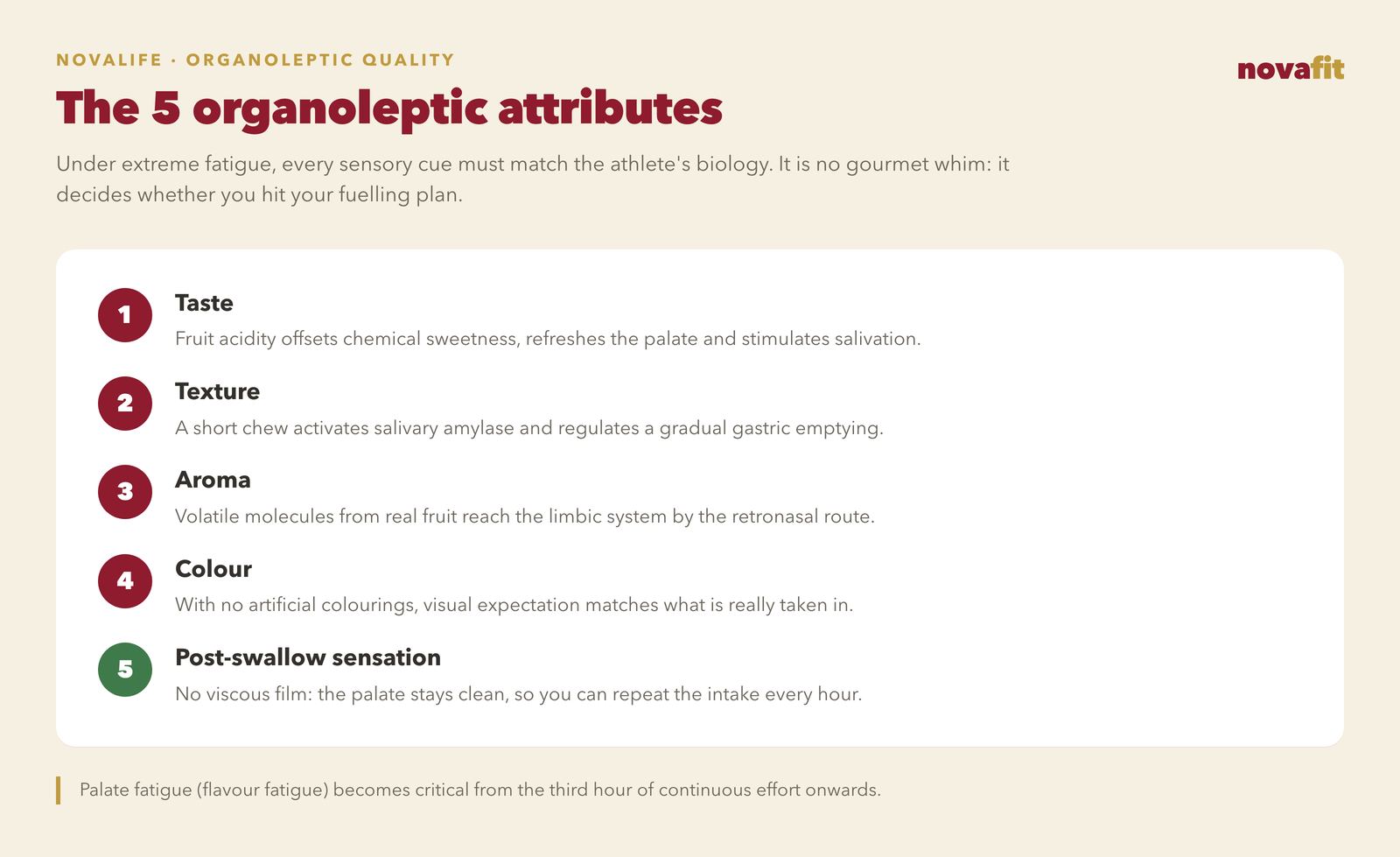
- Five sensory signals decide whether you carry on eating or not: taste, texture, aroma, colour and the aftertaste left behind once you have swallowed.
- The strategy changes with the sport. More solid textures for cycling, fluid gels for trail running, and alternating flavours in triathlon depending on the stage of the event.
- The palate is trained too, exactly like the stomach. Getting it used to the job little by little during your build-up avoids nasty surprises on race day.
Introduction: beyond carbohydrate and ratios
In long-distance cycling, trail running or middle and long distance triathlon, athletes live obsessed with numbers. We calculate grams of carbohydrate per hour with mathematical precision, we analyse whether our stomach copes better with a 1:0.8 or a 1:1.2 glucose-to-fructose ratio, and we hunt for the exact sodium concentration in citrate form to stave off dehydration.
All of that is solid, fundamental science. Yet the traditional supplement industry has systematically ignored a critical factor that destroys the best-laid fuelling plans: the organoleptic impact of what we swallow mid-effort. Organoleptic quality, understood as the set of properties of a food that we perceive through taste, texture, aroma, colour and mouthfeel, is neither a gourmet indulgence nor a marketing flourish. Under extreme fatigue, when the nervous system is overstimulated and blood flow to the stomach is minimal, how palatable a product is directly determines whether the athlete meets their energy targets or abandons the nutrition strategy altogether.
A gel or a bar with a theoretically perfect laboratory formulation is completely useless if the athlete cannot swallow it in the fourth hour of a race. In this article we look, through the lens of scientific evidence and current food law, at why the move towards real food and a controlled, well-executed production process is the decisive key to protecting your stomach and maximising your performance.
The physiology of effort: why do we reject food in endurance races?
What splanchnic ischaemia does to the athlete's stomach
Every endurance athlete knows the scene: you have been riding or running for hours, your glycogen stores are close to empty and you know perfectly well that if you do not take on energy, the next kilometre will be a nightmare. And yet you open the umpteenth gel of the day, catch that industrial syrup smell and your body reacts with immediate, visceral refusal. Nausea rises and the stomach shuts down completely.
This is not a lack of mental toughness; it is a protective physiological response. During prolonged physical exercise, the body enters a state of sympathetic nervous system dominance. To prioritise the delivery of oxygen and nutrients to the working skeletal muscles, it diverts blood flow away from the digestive tract, a physiologically driven phenomenon known as splanchnic ischaemia. The direct consequence is that the gut receives up to 80% less blood flow than at rest.
Palate fatigue, (*flavour fatigue*): the invisible barrier to performance
That drop in blood flow drastically alters the sensory receptors of the mouth and palate, changing how we perceive flavour. Intense artificial sweetness, perfectly acceptable at rest, becomes overwhelmingly cloying during effort and triggers the gag reflex on the spot. Products built on low-quality industrial syrups leave a viscous coating in the throat, (an adverse aftertaste), which the brain reads as a digestive threat, shutting down any desire to keep eating.
The evidence: industrial performance versus real food
Sports nutrition science has begun to study in earnest how sensory tolerance shapes race results. A key study published in the journal Frontiers in Nutrition, (Reinhard & Galloway, University of Stirling, 2022), (Ref 2), surveyed 1,081 endurance athletes, (runners, triathletes and cyclists), across a range of competitive levels about their fuelling habits during training.
Read with precision, the findings are revealing: only 19.3% of the participants fuelled exclusively on commercial sports nutrition products, and that group valued above all the convenience of taking them on during exercise. At the other extreme, 13.2% of the sample chose to fuel solely on ordinary everyday food during their volume training — and within that specific group, 84.6% gave as their main reason the importance of eating natural, minimally processed ingredients rather than purely industrial gels or bars, (Ref 2). It is a minority subgroup of the total sample, but the size of that figure makes plain how strong the preference is where it exists: those who actively choose real food during training do so, in the overwhelming majority of cases, out of a conscious rejection of the ultra-processed.
Why ultra-processed gels saturate your taste buds
Once an effort passes the 3-hour mark, repeated exposure to identical, monotonous chemical stimuli saturates the receptors of the palate. It is why so many athletes, elite and recreational alike, end up turning to real fruit or small, cleaner-tasting bites in the closing stages of ultras and long-distance events. They do it not because the calorie density per gram is higher, but because a genuine organoleptic profile is the only thing their nervous system can still tolerate once the palate has said "enough".
The role of artificial aromas in gastric rejection
What sets NOVAFIT apart is respect for nature's molecular complexity. Including between 30% and 50% real fruit pulp in our gels and bars introduces a bioactive, three-dimensional food matrix into the body. Natural fruit is not a decorative ingredient; it is a harmonious set of hundreds of volatile molecules, living organic acids, (malic and citric among them), and intrinsic structured water.
That richness of aromatic nuance provides a dynamic sensory stimulus that evolves on the palate as you chew or swallow. From a neurobiological point of view, this complexity is the key to keeping the athlete's reward circuit engaged. Unlike flat, linear stimuli, the flavour spectrum of real fruit stimulates the taste receptors in a balanced, sustained way, avoiding neurological saturation. Committing to whole ingredients such as banana, strawberry or papaya is therefore a high-end functional decision: it offers an authentic organoleptic experience that the nervous system recognises, welcomes and accepts naturally under extreme effort.
The 5 organoleptic attributes applied to sports nutrition
For sports nutrition to work under extreme fatigue, every sensory stimulus has to be aligned with the athlete's biology. NOVAFIT applies food science to turn the physical properties of ingredients into real metabolic advantages.
1. Taste: taking the edge off chemical sweetness with fruit acidity
Carbohydrate intake is non-negotiable in endurance performance. Because carbohydrates are molecularly sweet, the great challenge of supplementation is to stop that energy load saturating the taste bud receptors, which turn hypersensitive under the stress of training. NOVAFIT builds in high percentages of real fruit pulp. Fruit intrinsically supplies organic acids that counter sweetness, refresh the palate and stimulate salivation naturally.
2. Texture: activating salivary enzymes and progressive gastric emptying
Texture is the physical attribute that dictates how the stomach processes food. NOVAFIT offers a disruptive mechanical alternative: energy bars with a soft, chewy, gummy-sweet texture. This solid but tender consistency brings key physiological benefits: stimulation of salivary amylase through brief chewing that starts carbohydrate hydrolysis in the mouth itself, and progressive gastric emptying that avoids the osmotic hit of traditional gels.
3. Aroma: connecting fruit's volatile molecules with the limbic system
Before a single gram of glucose reaches the muscle cells, the brain has already assessed the supplement through smell. The olfactory bulb is wired directly into the limbic system, the brain region that runs survival responses. Using real natural fruit pulp instead of synthetic chemical aromas guarantees an authentic aromatic profile that the brain recognises, easing the psychological stress of forced feeding.
4. Colour: sensory coherence to avoid cognitive dissonance
The visual impact of food is the first step in the fuelling protocol. The human brain works by prediction: when the eyes see a particular colour, the digestive system starts secreting specific gastric juices in anticipation of a particular taste. The complete absence of artificial colourings keeps visual expectation aligned with what is actually swallowed.
5. Post-swallow sensation, (*after taste*): the key to tolerating a gel every hour
The after taste is the residue left on the palate and in the throat once the food has gone down. Low-quality stabilisers and industrial ingredients leave a permanent viscous film. Fruit pulp, dissolving cleanly without leaving technological residues, clears the palate and leaves a fresh sensation that makes it possible to repeat the intake systematically, exactly as planned.
Sports psychology: staying in the zone, (*flow state*), on race day
Sports psychology defines flow, (flow state), as a condition of total immersion and optimal performance. Staying there has one indispensable biological requirement: the absence of cognitive interruptions. If the supplement is an ultra-processed gel with an artificial, chemical taste that is less than wholly pleasant, the brain's attention shifts towards that negative experience and perceived exertion rises automatically. Training your nutrition also means educating the palate and the brain to associate the moment of feeding with a clean, safe experience free of gastric stress.
A practical guide by sporting discipline
Physiological demands, biomechanics and breathing patterns change dramatically from one discipline to another. Managing the organoleptic attributes therefore has to be adapted to each specific sporting scenario.
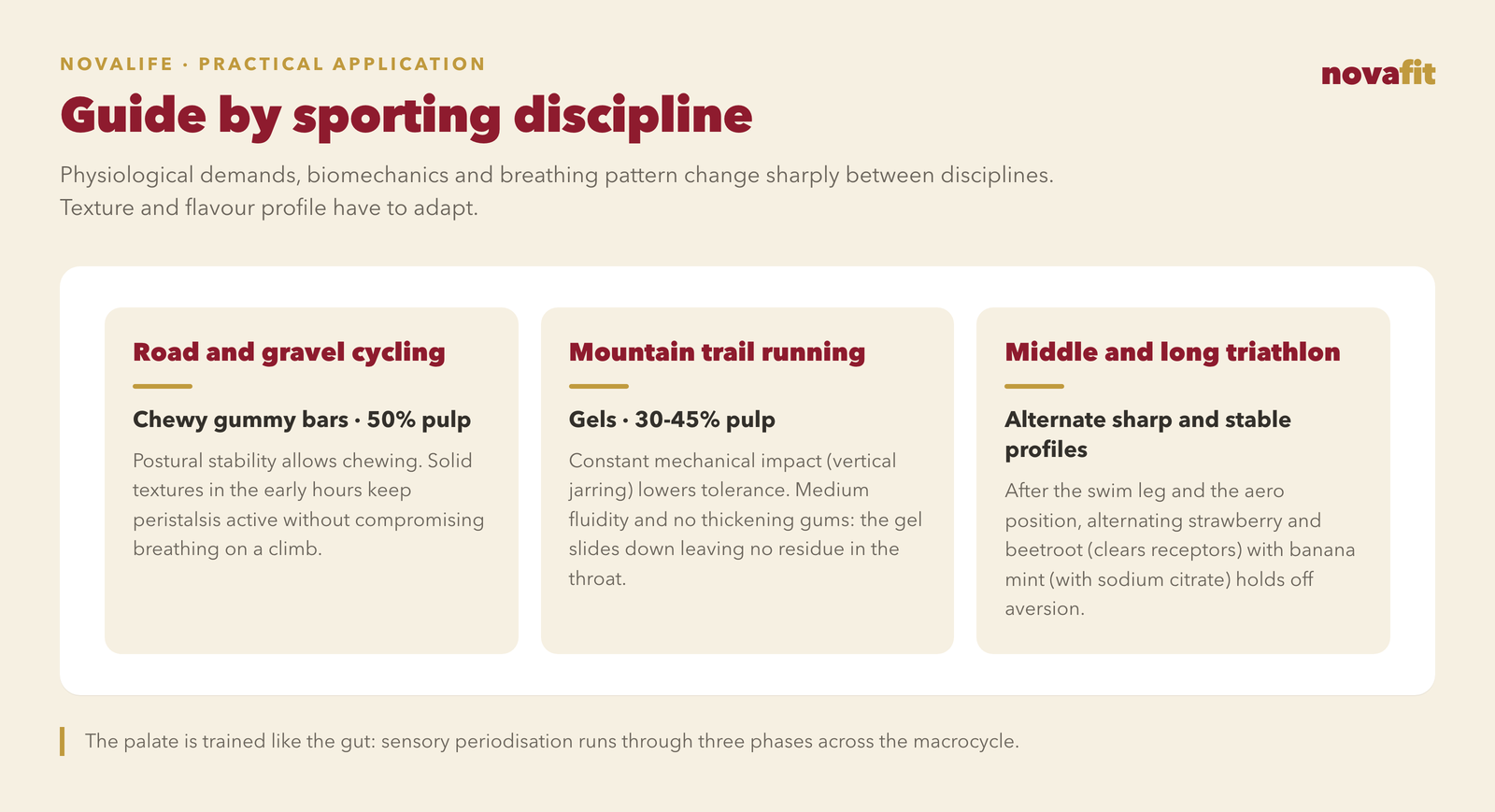
Road and gravel cycling
On the bike, postural stability allows slightly more efficient gastric emptying than running does, but speed and wind cause an imperceptible subclinical dehydration that constantly dries the mucous membranes of the mouth. On the road, the cyclist needs solid, chewable textures in the early hours to keep intestinal peristalsis active. The texture of gummy-style bars with 50% fruit pulp is ideal here: it stimulates salivation without demanding a chewing effort that would compromise breathing on a mountain pass, and it delivers a complex flavour profile, thanks to its combined technical sugars, that breaks the monotony of water and isotonic drink.
Mountain trail running
The mountain runner faces the worst digestive scenario of all: the constant mechanical impact against the ground, (vertical jarring). That pounding mechanically damages the stomach walls and drastically reduces tolerance to dense foods. On steep climbs or technical sections, chewing a hard bar is logistically unworkable and pushes the heart rate up. The trail runner benefits from gels with 30% to 45% real fruit pulp. By keeping an optimised intermediate fluidity and avoiding industrial thickening gums, (xanthan, for instance), the gel slides quickly down the oesophagus without leaving thick residues in the throat, easing the fatigue-driven vomiting reflex.
Middle and long distance triathlon
The triathlete comes out of the swim with salt or chlorinated water lingering in the mucous membranes and then adopts an aerodynamic tucked position on the bike that compresses the abdominal cavity. The transition to the run raises core body temperature, (core temperature). In this multi-variable state of biological stress, flat, hyper-sweet flavours accelerate aversion. The optimal protocol calls for alternating acidic fruit gels, (strawberry with beetroot, for example), which clean the chemical receptors of the mouth, with more stable flavours, (banana with mint, for example), enriched with sodium citrate to neutralise accumulated acidity.
The "palate training" protocol: sensory periodisation
Just as the gut needs anatomical adaptation to increase the number of SGLT-1 and GLUT-5 transporters, (digestive training), (Ref 1), the central nervous system and the taste buds require periodisation in order to tolerate high carbohydrate loads in a race without triggering palate fatigue. This evidence-based protocol breaks down into three non-negotiable phases across the preparation macrocycle:
- Phase 1: finding your sweetness saturation threshold, (weeks 12 to 8 before the target event). During low-intensity training, (Z2), the athlete should consume supplements at increasing rates, (from 40 g to 60 g/hour). The aim is to record the exact moment when the cloying sensation appears, or the defensive urge to drink plain water to wash the taste away. Combinations of acidic and neutral fruit pulp should be tested to map the individual limbic response.
- Phase 2: simulating ischaemia and multiple loads, (weeks 8 to 4 before the target event). In interval sessions or race-pace simulations, where blood flow to the stomach is minimal, organoleptic tolerance is trained by introducing technical gels with palatinose and maltodextrin. Including gels with real combinations, such as strawberry and beetroot, teaches the brain to recognise the volatile aromas under conditions of peripheral hypoxia, lowering the rate of retronasal aversion.
- Phase 3: automating the flow state, (the final 4 weeks). In the closing simulation sessions, the fuelling protocol must be executed exactly as it will be on race day. The athlete should take the supplement without looking at it, checking whether the texture, (gummy or fluid gel), interrupts their stride or pedalling concentration. If the sensory experience is clean and the taste clears from the mouth within seconds of swallowing, the palate is trained not to break the flow state in competition.
A comparative and biochemical look at the key ingredients
NOVAFIT's competitive advantage lies in the molecular interaction between its advanced energy sources and the biological matrices of real fruit. Here we break down the star compounds in the formulation:
Palatinose (isomaltulose)
At molecular level, palatinose is a disaccharide made up of glucose and fructose, exactly like ordinary sucrose. It carries, however, an isomaltose-type alpha-1,6 bond instead of the alpha-1,2 bond of common sugar. That structural difference is critical: the enzymes of the small intestine, (isomaltases), take between 4 and 5 times longer to break it. The physiological result is an extremely gradual release of glucose, with a low glycaemic index, (GI 32), which prevents sudden energy crashes and reactive hypoglycaemia while keeping fat oxidation rates stable.
Natural banana and papaya
Banana pulp at 30% or 50% is not there as a mere flavouring; it supplies a matrix of unrefined starches and intracellular potassium that lowers the total osmolality of the gel in the stomach, helping it empty faster. Papaya, for its part, is intrinsically rich in papain, a natural proteolytic enzyme that helps soften the digestion of any residue already in the stomach, reducing inflammation of the digestive lining under the stress of exercise.
Strawberry with beetroot: sensory and vascular synergy
This combination represents the peak of functional formulation. Beetroot delivers a massive concentration of inorganic nitrates, (NO3-). Once ingested, bacteria in the saliva reduce them to nitrites and the body then converts them into nitric oxide, (NO), under low-oxygen conditions. Nitric oxide is a powerful vasodilator that improves mitochondrial efficiency and lowers the oxygen cost of muscular work.
Pure beetroot juice, however, has an intense earthy taste, (down to geosmin), that provokes strong organoleptic rejection in a race. NOVAFIT solves this by combining it in exact proportion with 30% natural strawberry pulp, whose citric acids mask geosmin's earthy note, turning a purely vascular compound into a fresh and highly palatable experience.
Frequently asked questions about sports nutrition and organoleptics
1. Some nutritional approaches argue for removing flavour entirely to avoid saturation. Why include high percentages of real fruit pulp alongside the technical sugars here?
In prolonged efforts there are two scientifically valid ways to fight palate fatigue: absolute neutrality or natural complexity. Removing flavour is a legitimate strategy for silencing the receptors of the mouth. Research in neurobiology shows, however, that 30% to 50% real fruit pulp works as a positive functional stimulus. Natural fruit supplies intrinsic organic acids and volatile aromas that actively counter the sweetness of the technical carbohydrates performance requires, such as maltodextrin or palatinose. This combination clears the palate after each intake, prevents the sensory aversion caused by traditional industrial gels, and is the best option for athletes who need a real, chewable food stimulus to keep the digestive circuit active.
2. What is the advantage of sodium in "citrate" form over ordinary salt (sodium chloride)?
From the perspective of digestive physiology during exercise, sodium citrate acts as a gastric buffer, reducing the exercise-induced acidity of the stomach. On top of that, in organoleptic terms it gives a much softer, subtler salty taste. That balances the sweetness of the fruit and the technical sugars without saturating or irritating the taste buds after several hours of continuous consumption.
3. If the supplement already contains complex carbohydrates and sugars, doesn't the fruit aroma overload the athlete's nervous system?
Quite the opposite, provided the aroma comes from real fruit and not from chemical synthesis. Smell is the only sense wired directly into the limbic system, the brain centre that governs survival instinct and nausea. Under metabolic stress, the brain reads laboratory-made artificial aromas as aggressive synthetic compounds, which triggers gastric rejection. The volatile molecules of natural strawberry, banana or papaya pulp are identified retronasally as evolutionarily safe nutrients. Far from saturating, natural aroma acts as a cognitive facilitator that smooths the intake of the high carbohydrate doses performance demands.
4. What exactly is "palate fatigue", and when does it appear?
Palate fatigue, (flavour fatigue), is a neurological and sensory phenomenon that usually becomes critical from the third hour of continuous effort onwards. It occurs when taste receptors become desensitised to a monotonous, industrial sensory stimulus. The body's alarm system then produces visceral rejection, nausea or disgust, causing the athlete to stop eating and compromising performance in the decisive phase of the event.
Bibliography and scientific references
- Jeukendrup, A. E. (2014). A step towards personalized sports nutrition: carbohydrate intake during exercise. Sports Medicine, 44(Suppl 1), 25-33.
- Reinhard, C., & Galloway, S. D. R. (2022). Carbohydrate intake practices and determinants of food choices during training in recreational, amateur, and professional endurance athletes: a survey analysis. Frontiers in Nutrition, 9, 862396.
- Vogel, R. M., et al. (2022). Athlete perceptions of flavored, menthol-enhanced energy gels ingested prior to endurance exercise in the heat. Journal of the International Society of Sports Nutrition, 19(1), 45-62.
- Regulation (EU) No 1169/2011 of the European Parliament and of the Council of 25 October 2011 on the provision of food information to consumers.
Article written by the Novafit team.
Novafit: the energy you need, with the taste you deserve.
Related articles
- Do lactate gels work? What the science already confirms and what is still unproven
- Three Gels, Three Fruits, One Formula: The Science Behind NovaFit Energy Gels
- The Hypoglycemic Rebound: The Silent Enemy That Wrecks Your Race in the Final Kilometers
- What exactly does a NOVAFIT gel do in your body? The science, step by step