An honest look at carbohydrate, media bias and the new exogenous lactate boom in endurance sport.
In short
The lactate mechanism is solid science; that taking it by mouth improves endurance performance is not yet demonstrated. It is worth separating two levels that the public conversation constantly blurs: the physiological mechanism, and the clinical evidence that this mechanism translates into a real, repeatable improvement in competition.
- Carbohydrate remains the undisputed foundation. Glycogen stores are limited (80–100 g in the liver, 300–500 g in muscle), which makes feeding carbohydrate from outside one of the best-supported interventions in the history of sports medicine.
- The ceiling was never maltodextrin, it was relying on a single source. The SGLT1 transporter saturates at around 1.0–1.2 g/min (roughly 60 g/h). Fructose enters through an independent route, GLUT5.
- Multiple transportable carbohydrates are the gold standard. From Jeukendrup and Currell (2008) through to Podlogar et al. (2022), with ratios from 2:1 to 1:0.8 and intakes of 90–120 g/h.
- The lactate shuttle is real. Brooks showed that lactate is a fuel, a gluconeogenic precursor and a signalling molecule. That much is not in dispute.
- Swallowing lactate is a different question altogether. McCarthy et al. (2024) found that oral sodium lactate did not significantly raise blood lactate and did cause moderate-to-severe gastrointestinal effects.
- The one documented exception is a narrow one. In very brief efforts of supramaximal intensity, (at or above VO2max), certain lactate salts show a mild buffering effect against metabolic acidosis, but that finding does not carry over to long-distance endurance events.
- Lactate products are themselves more than 85–90% conventional carbohydrate by weight. Any performance observed comes above all from that well-established carbohydrate base.
- What holds for the professional peloton does not simply carry over to the recreational athlete. The studies have mostly been run on small samples of elite athletes, whose intestinal absorption capacity and medical supervision are a world away from the amateur's.
Introduction
Over the past few years, sports nutrition in endurance disciplines such as cycling, triathlon and trail running has gone through an unprecedented period of ferment. On one side, a current has emerged, still a minority but increasingly visible on social media and in forums, of athletes who regard maltodextrin and traditional carbohydrate sources with suspicion, wrongly associating them with digestive trouble or insulin spikes. On the other, driven by eye-catching headlines in the specialist sports press and by the arrival of pioneering brands in the professional peloton, one concept has burst into the spotlight: exogenous lactate, the practice of supplementing lactate directly through gels and drinks taken during training.
It is excellent news that bioenergetics and nutrition science keep pushing at new frontiers. In an age of fast information, however, it is vital for the athlete, the coach and the health professional to tell apart two things that are constantly conflated: the physiological mechanism, (the fascinating biochemical processes that take place at cellular and mitochondrial level), and the demonstrated clinical evidence, (hard proof that ingesting an ingredient translates into a real, measurable and repeatable improvement in race performance).
What follows is a thorough look at the complete fuelling map for endurance exercise: from the most firmly established metabolic pillars to the most recent hypotheses still under investigation, taking in the media narrative, the critical voices within sports medicine and the real-world limits for the recreational athlete.
1. The starting point: why carbohydrate is still the undisputed foundation
To make sense of the current debate around any new ergogenic supplement, it helps first to revisit the biological fundamentals that govern performance in prolonged efforts.
During moderate to high intensity exercise, (above the first ventilatory or lactate threshold), carbohydrate is quantitatively the most efficient and most important energy substrate available to skeletal muscle. Because endogenous glycogen stores — held mainly in the liver, (approx. 80–100 g), and in muscle mass, (approx. 300–500 g depending on lean mass and training status) — are strictly limited, their gradual depletion leads inevitably to central and peripheral fatigue, a sharp drop in watts per kilo and the dreaded "wall", or bonking. This is precisely why feeding carbohydrate during activity is one of the best-supported, best-evidenced interventions in the history of sports medicine.
The intestinal ceiling and the multiple transporter solution
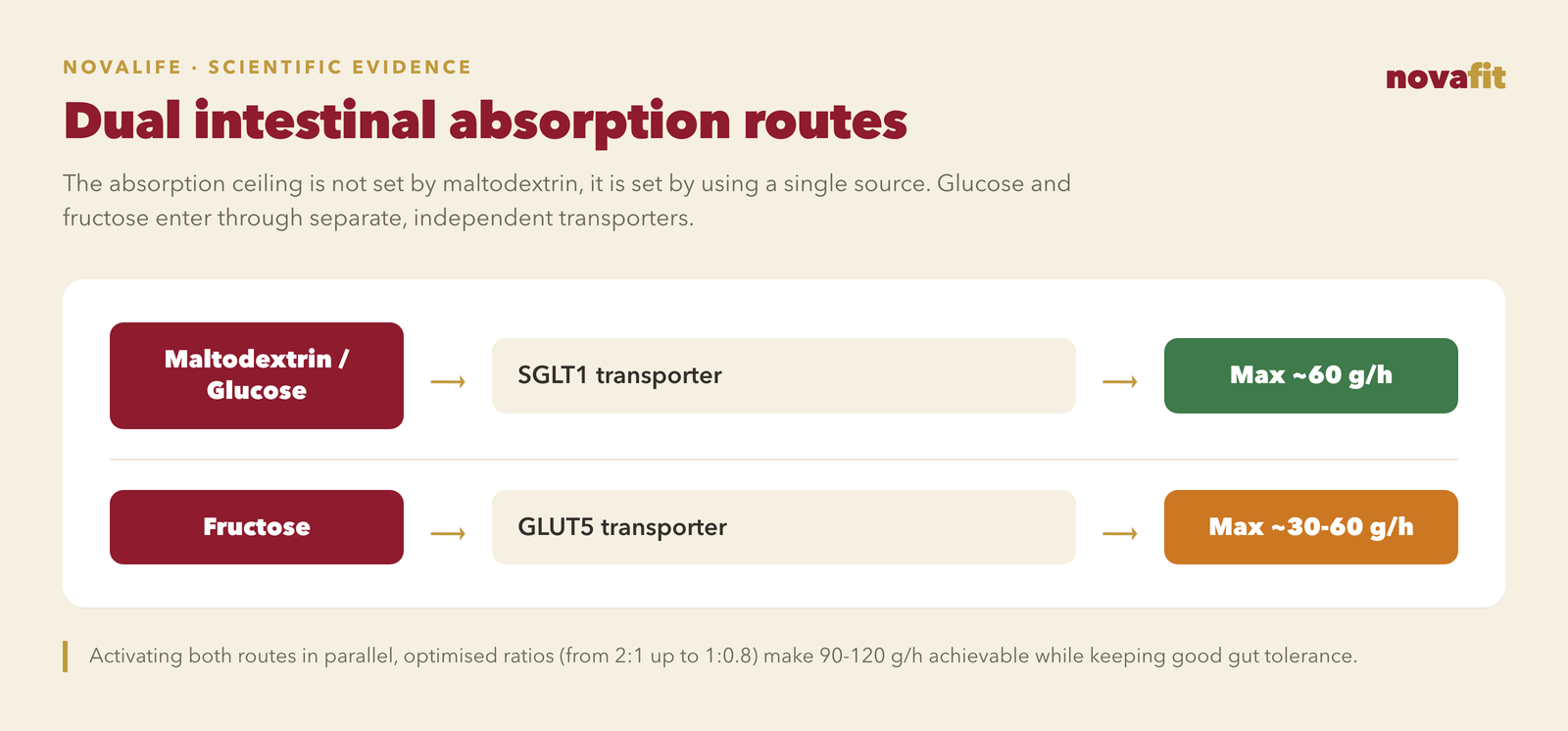
Historically, the real obstacle to fuelling on the move has never been the muscle's capacity to oxidise glucose, but the digestive system's capacity to absorb it without saturating. The sodium-dependent glucose transporter (SGLT1), located in the membrane of the intestinal enterocytes, has a physiological saturation ceiling of around 1.0–1.2 grams per minute, (roughly 60 grams per hour). When an athlete tries to exceed that rate on glucose or glucose polymers alone, (maltodextrin, for instance), the transporters saturate. The unabsorbed sugar stays in the intestinal lumen, raising osmolality, drawing in water by osmosis and triggering gastrointestinal distress, bloating, cramps and diarrhoea.
The answer to that bottleneck was not to demonise maltodextrin — whose bad reputation we unpack in a separate article — but to apply a crucial physiological discovery: multiple transportable carbohydrates. Fructose uses a completely independent, parallel intestinal transport route via the GLUT5 protein. Combining glucose/maltodextrin sources strategically with fructose activates both transporters (SGLT1 and GLUT5) at the same time.
Pioneered in the mid-2000s by the work of Dr Asker Jeukendrup and Dr Kevin Currell, this strategy has been extensively confirmed in the recent scientific literature. Contemporary research, (Podlogar et al., 2022, among others), shows that optimised glucose-to-fructose ratios, (ranging from 2:1 to 1:0.8 or 1:1 at high intakes of up to 90–120 g/h), maximise exogenous carbohydrate oxidation rates, spare liver glycogen and maintain excellent digestive tolerance in trained athletes.
In short: the multiple transportable carbohydrate matrix remains the uncontested gold standard of endurance sports nutrition, (the benchmark any new ingredient has to beat).
2. The new piece of the map: the physiology of exogenous lactate
To understand why lactate has captured the attention of researchers and supplement formulators alike, we first have to dismantle a stubborn myth in popular sporting culture.
From "metabolic waste" to elite fuel: the lactate shuttle
For decades lactate, (routinely and wrongly confused with lactic acid), was unfairly filed away as a toxic metabolic by-product, the direct cause of next-day muscle soreness and the main culprit behind muscular fatigue. Modern bioenergetics research, led above all by the seminal work of Professor George A. Brooks (University of California, Berkeley) from the 1980s onwards, has shown that view to be profoundly mistaken.
Through his formulation of the lactate shuttle theory, (Lactate Shuttle, in Brooks' original phrasing), he demonstrated that lactate is in fact an extraordinarily dynamic metabolic intermediate and a first-rate fuel:
- An aerobic fuel cell: fast-twitch muscle fibres (type II) produce lactate during intense efforts; that lactate is carried by monocarboxylate transport proteins (MCT1 and MCT4) to slow-twitch fibres (type I), cardiac muscle and the brain, where it is converted back into pyruvate and fed into the mitochondria to produce ATP highly efficiently.
- A gluconeogenic precursor: in the liver and kidneys, lactate is converted back into glucose through the Cori cycle.
- A signalling molecule, (the "lactormone"): lactate acts as a cell-signalling molecule capable of stimulating mitochondrial biogenesis, angiogenesis and adaptation to endurance training.
The big question: does swallowing exogenous lactate actually work?
Given that endogenous lactate is an excellent metabolic fuel, the supplement industry's hypothesis looks reasonable enough: if we deliver lactate directly by mouth during exercise, do we gain an extra energy source that spares glycogen and improves performance?
This is where science demands rigour and restraint, because the literature paints a complex, heavily qualified picture:
- Absorption and the osmotic barrier: unlike lactate produced internally, supplemented lactate has to cross the digestive tract. To be formulated into powders or gels, lactate is usually bound to mineral salts, (sodium lactate, calcium lactate, potassium lactate). The reference study published by McCarthy et al. (2024) in the Journal of Applied Physiology examined oral sodium lactate ingestion across multiple concentrations and conditions. The results were unambiguous: oral ingestion did not significantly increase blood lactate concentrations and produced a high incidence of moderate-to-severe gastrointestinal side effects, (nausea and vomiting included). The explanation lies in the very high osmotic load and digestive hypertonicity of these saline compounds.
- Results in real-world performance: the vast majority of placebo-controlled trials in endurance events, (20 km or 40 km cycling time trials, for example), using tolerable doses have found no statistically significant improvements in performance or in mean power output.
- *Specific acid-base contributions, (buffering):* in a handful of very particular supramaximal protocols, (at or above VO2max, with brief intermittent efforts), certain lactate salts have shown a mild buffering effect against metabolic acidosis, (raising blood bicarbonate much as sodium bicarbonate does), but their effects on long-distance endurance remain unsupported.
It is also worth noting that commercial formulations promoting lactate as a "revolutionary" ingredient still contain, as their majority ingredient, (more than 85-90% by weight), the traditional carbohydrate matrix (glucose, maltodextrin and fructose). Any performance observed therefore comes from that well-understood carbohydrate base, and not necessarily from the small added dose of lactate.
3. The lactate boom in the sports press, and the sceptical counter-current
3.1. Sensational headlines and the "professional peloton" effect
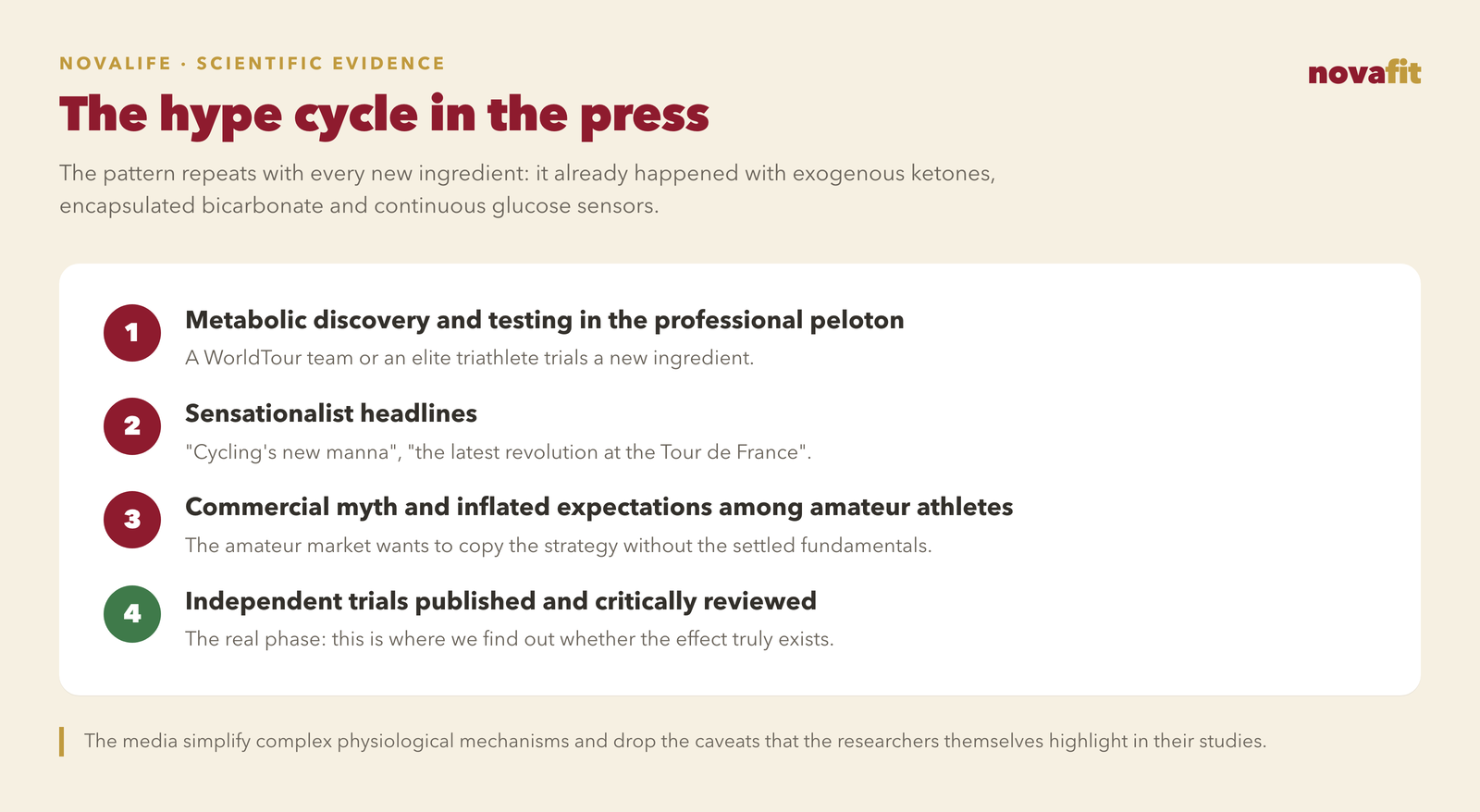
In recent months, large media outlets, sports supplements in the general press and specialist cycling websites have given space to striking headlines: "The Tour de France's latest revolution", "The pros' metabolic manna" or "The lactate gels that change the rules of the game".
That coverage reflects a recurring phenomenon in the sports industry: the trickle-down effect of elite sport. When word gets out that a WorldTour team or a world-class triathlete is testing a new protocol or ingredient, (as happened in their day with exogenous ketones, encapsulated bicarbonate or continuous glucose monitors), the amateur market responds with an immediate urge to copy the strategy.
The media, however, often simplify complex physiological mechanisms and leave out the caveats the researchers themselves stress in their papers. The result is an aura of "secret ingredient" or "magic formula" promising marginal gains before the fundamentals have been put in place.
3.2. The critical voice of science and sports nutrition
Set against the marketing enthusiasm, some of the most influential figures in sports science and nutrition medicine have adopted a more reflective, critical tone.
Internationally respected science communicators and researchers — Dr Asker Jeukendrup on his MySportScience platform among them — have recently published reviews on the topic under telling titles: "Lactate: from villain to fuel to hype?". The scientific community stresses several key points that puncture the mythology:
- Confusing endogenous production with exogenous supplementation: the fact that the body uses lactate naturally through cellular metabolism does not automatically mean drinking lactate enhances that process. The body produces tens of grams of lactate per hour during intense exercise; adding 5 or 8 grams of lactate by mouth in a gel represents a minimal fraction which, to make matters worse, faces serious intestinal absorption problems.
- The digestive toll of the salt load: clinical nutritionists working with professional teams warn that the mineral load, (sodium, calcium or potassium), needed to stabilise lactate in salt form raises the osmolality of the formulation. In real race conditions, with heat and partial dehydration, that increases the risk of the gut shutting down exponentially.
- The principle of metabolic caution: professors of mitochondrial bioenergetics and exercise physiology, such as Dr Jesús Rodríguez Huertas (University of Granada), point out that introducing exogenous metabolites in excess could even interact in unwanted ways with the body's own endogenous signalling pathways. Independent, randomised, double-blind clinical trials are needed to establish genuine long-term safety and efficacy before any recommendation for widespread use.
3.3. The extrapolation bias: the missing data on non-professional cyclists and runners
One of the most serious and least discussed issues in sports coverage is the enormous methodological gap between studies in elite athletes and the reality of the recreational or non-professional athlete.
Rigorous scientific literature carried out specifically in cohorts of amateur cyclists, runners or triathletes is notably hard to find. The overwhelming majority of the available data comes from two limited sources:
- Laboratory trials with very small samples, (often between 8 and 12 subjects), made up of young, very high-performing male athletes.
- Informal, empirical observation inside professional cycling structures.
Why is extrapolating from a professional to a recreational athlete such a serious mistake?
- Metabolic flexibility and oxidative capacity: a professional cyclist has significantly greater mitochondrial density, muscle blood flow and intestinal transporter numbers (SGLT1 and GLUT5) than a recreational athlete. A professional can assimilate and oxidise 100-120 g/h of carbohydrate because they have trained their digestive system over thousands of kilometres a year. The amateur who tries to copy those intakes, or to add high-osmotic-load ingredients such as lactate, saturates their digestive tract with remarkable ease.
- Relative intensity and energy expenditure: endogenous lactate flux in an athlete pushing 400 W up a mountain pass is massive. In a club cyclist turning 180 W, or a runner holding 5:15 min/km, the metabolic profile is radically different and the body's absolute priority is still oxidising well-tolerated exogenous glucose and intramuscular fat.
- Medical supervision versus the recreational athlete on their own: riders in the professional peloton take supplements under close medical and laboratory monitoring, (blood pH checks, electrolytes, continuous lactate readings, digestive ultrasound). The recreational runner or cyclist has none of that back-up, so experimenting with highly osmotic substances during a sportive or a marathon can wreck months of preparation through gastrointestinal problems.
3.4. What doctors and nutritionists agree on for fuelling "during" exercise
Pulling together the assessments of nutritionists' professional bodies, sports medicine specialists and peer-reviewed review papers, the current consensus on what to consume during physical activity comes down to a few clear guidelines:
- The absolute priority: secure an adequate intake of soluble carbohydrate, (between 30 g/h and 90 g/h depending on the duration and intensity of the event), using proven multiple transportable carbohydrate matrices.
- Hydration and sodium replacement: sodium remains the key electrolyte for maintaining blood volume and supporting glucose co-transport in the intestine.
- Caution with fashions: exogenous lactate supplements, ketones and complex buffering agents should currently be regarded as experimental ingredients still under evaluation. They must never replace the basic carbohydrate protocol, nor be tried for the first time on the day of an important race.
4. Side-by-side comparison of the scientific evidence
To set out the current scientific position of both nutritional strategies clearly and directly, the table below summarises the key parameters supported by the literature:
| Parameter assessed | Multiple transportable carbohydrates (glucose/maltodextrin + fructose) | Oral exogenous lactate (lactate salts) |
|---|---|---|
| Physiological mechanism | Well established and demonstrated: simultaneous, parallel use of the SGLT1 and GLUT5 intestinal transporters. | Plausible but complex: based on the lactate shuttle, though its absorption and use as fuel when taken by mouth are open to question. |
| Performance evidence | Solid, consistent and replicated: decades of trials confirm delayed fatigue and preserved performance. | Limited and inconsistent: no clear improvements in endurance events; possible marginal benefits in short sprints. |
| Gastrointestinal tolerance | High tolerance: formulated at appropriate ratios (2:1 or 1:0.8), they significantly reduce the risk of discomfort. | Variable to problematic: the high osmotic load of lactate salts produces a high rate of nausea and discomfort. |
| Degree of consolidation | Established: the gold standard in international sports nutrition guidelines (ACSM, ISSN). | Emerging / under investigation: at the field-testing and basic research stage. |
| Applicability for recreational athletes | Direct and recommended: a clear benefit for any athlete training for more than 60-90 minutes. | Not advisable without prior testing: high risk of digestive discomfort through lack of adaptation and individualisation. |
5. The Novafit approach: technical rigour, a multi-level matrix and small-batch production
At Novafit, our product development philosophy starts from a non-negotiable premise: formulate strictly on the basis of consolidated scientific evidence, while keeping a close watch on the literature so that we can evolve as soon as new ingredients prove genuinely effective and safe.
We do not believe in passing fashions, nor in adding ingredients at token doses, ("nutritional marketing"), that can compromise an athlete's digestion. That is why the design of our energy gels answers to demanding technical criteria:
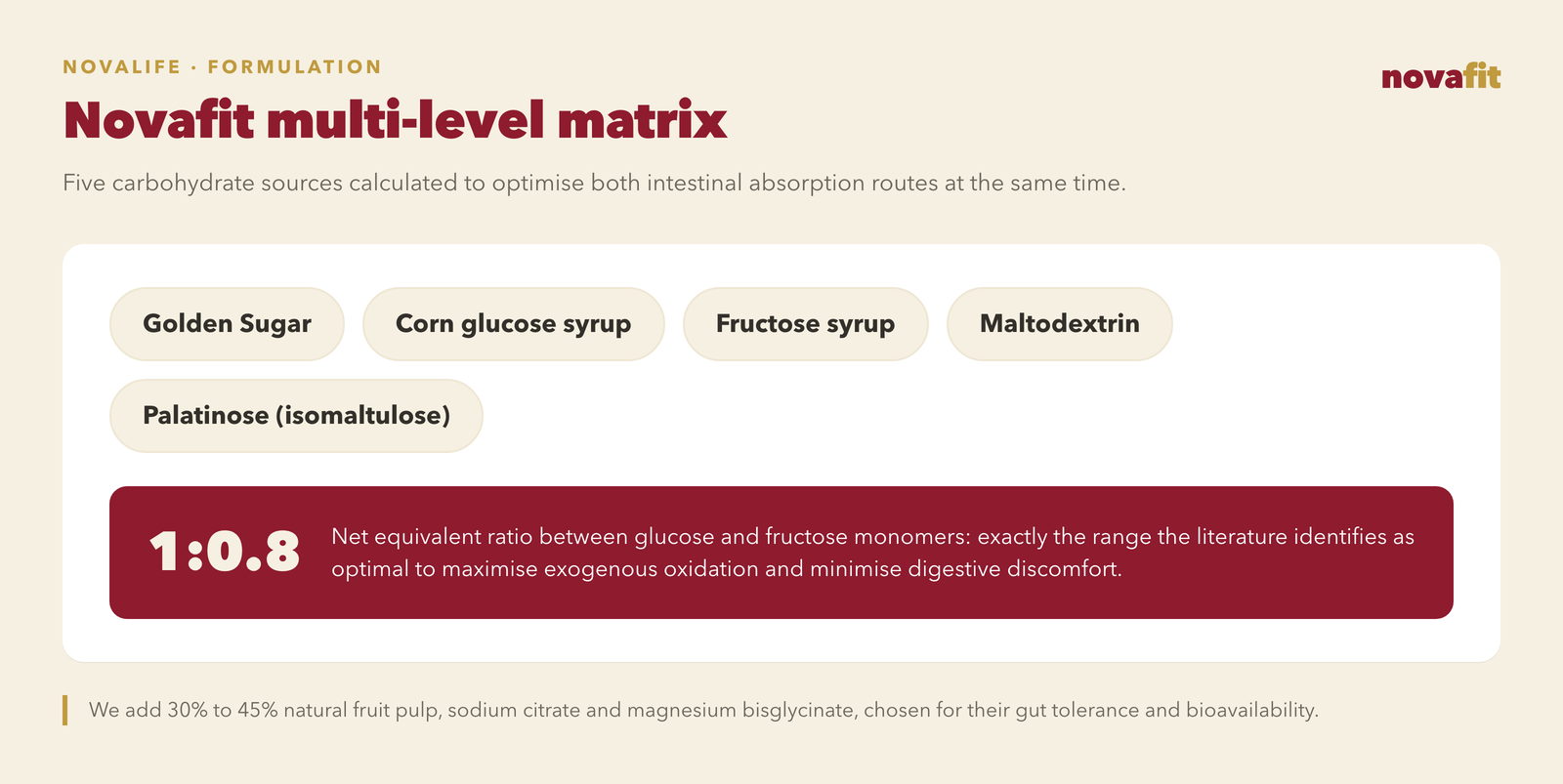
- A 5-source carbohydrate matrix: we combine Golden Sugar, corn glucose syrup, fructose syrup, maltodextrin and Palatinose (isomaltulose). This multi-level blend is calculated to deliver a net equivalent ratio between glucose and fructose monomers of 1:0.8, optimising the SGLT1 and GLUT5 absorption pathways precisely and supporting sustained energy release without insulin peaks and troughs.
- Real fruit for natural assimilation: we build in between 30% and 45% natural fruit pulp, which gives a fluid texture, a genuine taste and a contribution of micronutrients and organic water that helps gastric emptying.
- Highly bioavailable organic minerals: instead of harsh mineral salts, we choose sodium citrate and magnesium bisglycinate, selected for their outstanding solubility, excellent absorption and gentleness on the gastric lining.
- Controlled small-batch production: every one of our products is made by hand in our own workshop, which lets us control each stage of the process and guarantee products that are vegan, lactose-free and gluten-free.
Frequently asked questions
Below we answer, directly and concisely, the questions athletes, cyclists and runners most often ask about fuelling during exercise and the lactate debate:
Why is carbohydrate still the king of endurance nutrition?
Because it is the most efficient metabolic fuel the human body can oxidise quickly to produce ATP during moderate to high intensity exercise. Since endogenous glycogen stores are limited, feeding exogenous carbohydrate is the only proven way to hold off energy depletion, maintain blood glucose and sustain performance in prolonged efforts.
What does the multiple transportable carbohydrate strategy involve, and why does it prevent digestive trouble?
The gut has a glucose transporter (SGLT1) that saturates at around 60 g/h, (1 g/min). If you take only glucose or maltodextrin above that figure, the excess stays in the intestine and causes discomfort. Adding fructose activates a second, independent transporter (GLUT5). That way you can absorb and oxidise 90 g/h or more in complete digestive comfort.
What is the lactate shuttle (Lactate Shuttle), and why did it change how we understand this metabolite?
It was demonstrated by Professor George A. Brooks and proved that lactate is not toxic waste but a vital metabolic intermediate. Lactate produced by some muscle fibres is transported to other fibres, to the heart or to the brain to be reused as aerobic energy.
What does the current scientific evidence say about how effective exogenous lactate gels are?
The clinical evidence in real-world performance is very limited and inconsistent. The great majority of controlled endurance time-trial studies show no significant improvement in times or watts. Some trials report modest benefits confined to short, maximal efforts near VO2max, but not in long-distance events.
Why can oral lactate supplements cause nausea or gastrointestinal problems?
Because formulating lactate into a gel or a drink means binding it to minerals to form salts, (sodium lactate, for instance). A key study (McCarthy et al., 2024) showed that the high osmolality and digestive hypertonicity of these saline doses frequently cause gastrointestinal discomfort, including nausea and vomiting, without usefully raising blood lactate.
Why shouldn't we apply the professional peloton's strategies directly to recreational athletes?
Because there is a strong extrapolation bias. Professional cyclists have extraordinary digestive assimilation capacity and metabolic conditioning, and they compete under constant medical supervision. Amateur and recreational athletes have neither those parameters nor specific studies supporting the use of osmotically complex ingredients such as lactate in their training ranges.
How does Novafit approach the formulation of its energy gels for the endurance athlete?
At Novafit we back consolidated evidence: a multi-level matrix of 5 carbohydrates with a glucose-to-fructose ratio of 1:0.8, combined with natural fruit pulp (30-45%), organic mineral salts (sodium citrate and magnesium bisglycinate) and small-batch manufacturing in our own workshop, gluten-free and suitable for vegans.
References and further reading
- Jeukendrup, A. E., & Currell, K. (2008). Superior endurance performance with ingestion of multiple transportable carbohydrates. Medicine & Science in Sports & Exercise, 40(2), 275-281.
- Podlogar, T., Bokal, Š., Cirnski, S., & Wallis, G. A. (2022). Increased exogenous but unaltered endogenous carbohydrate oxidation with combined fructose-maltodextrin ingested at 120 g/h vs 90 g/h. European Journal of Applied Physiology.
- McCarthy, S. F., Bornath, D. P. D., Tucker, J. A. L., & Hazell, T. J. (2024). Oral sodium lactate ingestion does not increase blood lactate concentrations and is accompanied by moderate-to-severe gastrointestinal side effects. Journal of Applied Physiology, 137(5), 1279-1284.
- Brooks, G. A. (1986). The lactate shuttle during exercise and recovery. Medicine & Science in Sports & Exercise, 18(3), 360-368.
- Jeukendrup, A. E. (2024). Lactate: from villain to fuel to hype? MySportScience Educational Portal.
- Rodríguez Huertas, J. (2023). Revisiones sobre bioenergética mitocondrial y metabólica del lactato en el ejercicio físico. Universidad de Granada.
Article written by the Novafit team.
Novafit: the energy you need, with the taste you deserve.