Disclaimer: "This calculator offers general guidance based on published scientific recommendations. It does not replace the advice of a sports nutrition professional, especially if you have a medical condition."
The simple formula for working out how many gels and bars to carry, and when to take each one.
IN SHORT
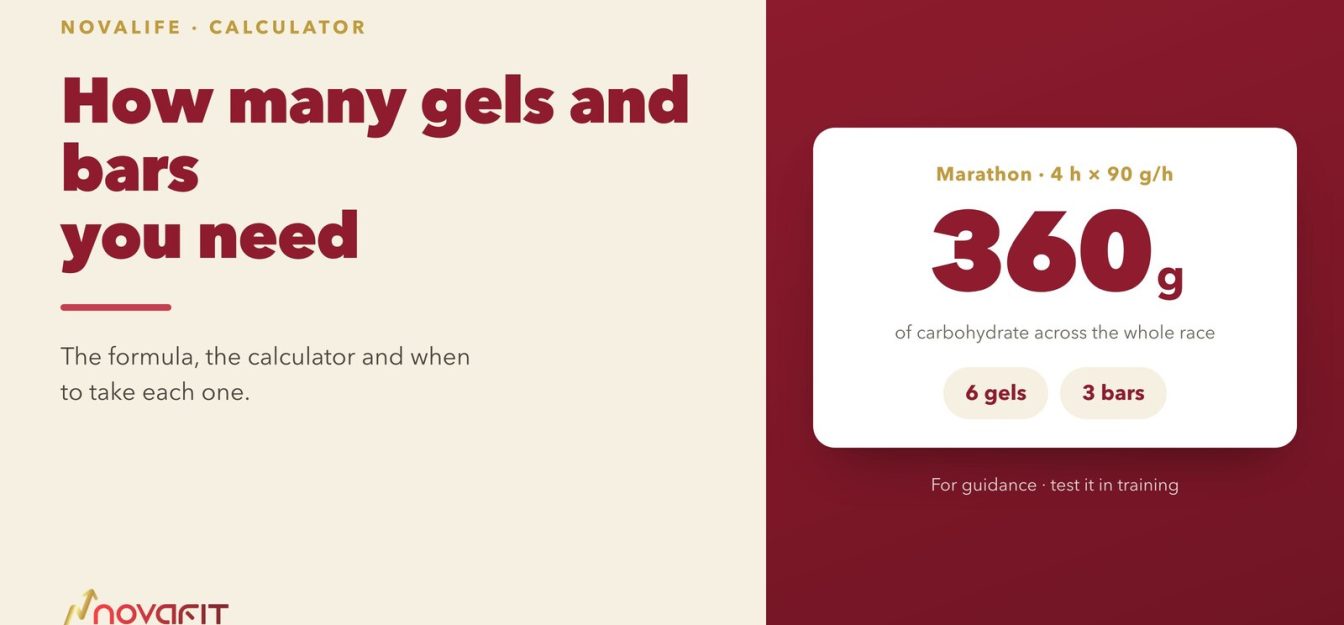
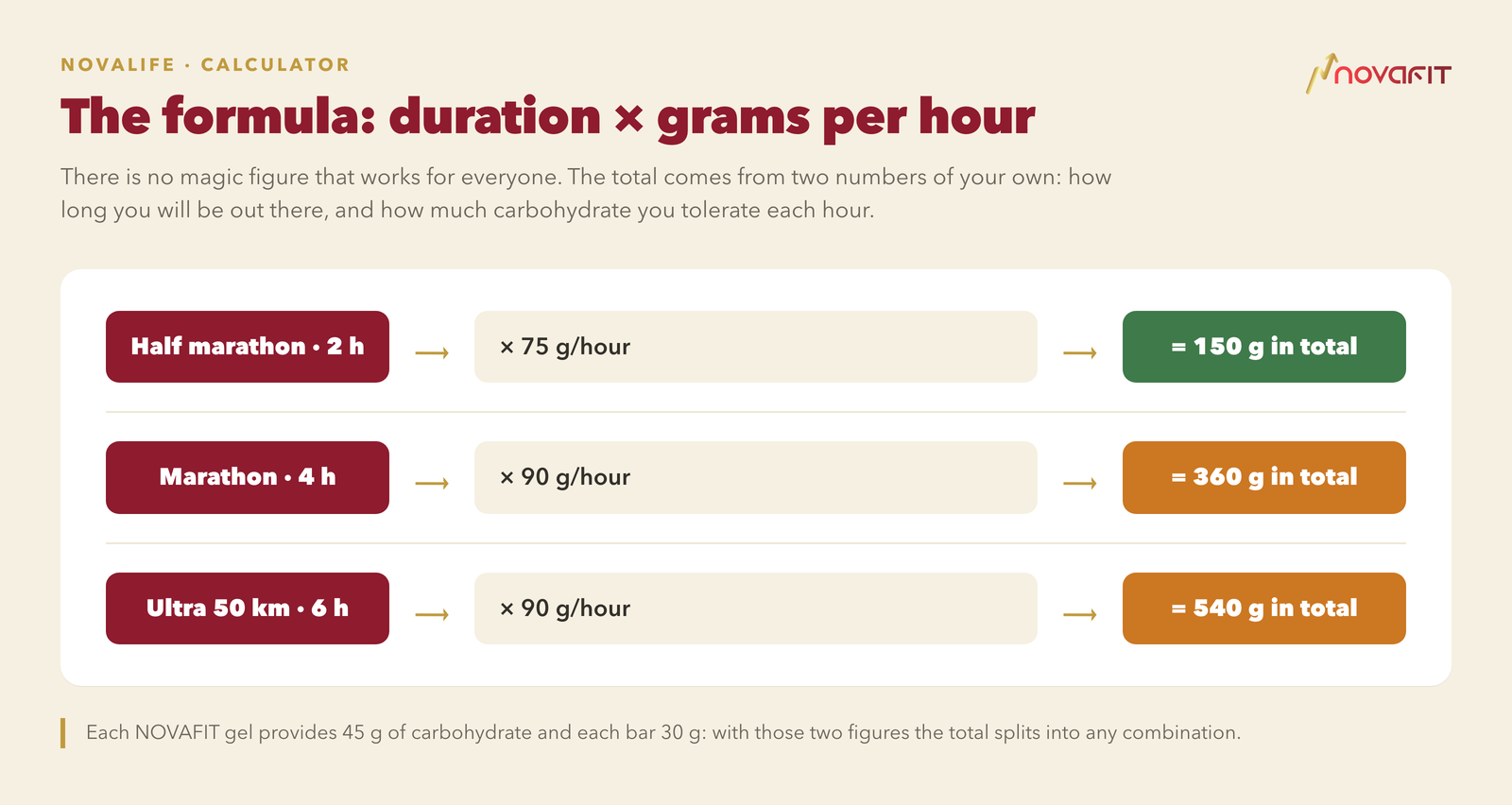
There is no magic figure of "a gel every 45 minutes" that works for everyone. What there is, is a simple formula: how long you are out racing × how many grams of carbohydrate you tolerate per hour. That tells you exactly how many gels and bars you need, and gives you a clear criterion for deciding which one to take at each moment.
- It all starts with a target of grams of carbohydrate per hour. Between 60 and 90 g/hour is the gold standard for most trained athletes; beginners should start lower (30-60 g/h) and train their tolerance gradually.
- The total figure comes from multiplying that target by your hours of racing. That already tells you how many grams you need in total; the rest is splitting them between gels and bars.
- NOVAFIT gels provide 45 g of carbohydrate each; the bars, 30 g. With those two figures you can work out any combination.
- The bar works better at the start and on flat sections; the gel, at the moments of highest intensity. The bar's solid texture asks for a little more digestive calm; the gel slides down fast when the body no longer wants to "chew".
- Nothing should be tried for the first time on race day. The exact combination is tested and adjusted in long training sessions, never for the first time on the start line.
Introduction: the question everyone asks before a race
"How many gels do I need?" is one of the most searched questions by any runner or cyclist before a long event, and it almost never has a clear answer. Most guides give generic figures ("a gel every 45 minutes") that ignore something fundamental: every athlete tolerates a different amount of carbohydrate per hour, and every moment of the race calls for a different format of energy.
In this article we give you the exact formula to calculate your gel and bar nutrition according to your race duration and your level of digestive training, plus a clear criterion for when each format suits best.
1. The starting point: your carbohydrate target per hour
The body's glycogen stores are limited. That is why, in any effort lasting more than an hour, replacing carbohydrate during the race is one of the performance levers best supported by sports science. The amount you can absorb depends on how much you have trained your digestive system:
| Level | CHO target per hour | When to use it |
|---|---|---|
| Beginner | 30-60 g/hour | First long races or little experience taking food on the move |
| Intermediate | 60-90 g/hour | You already train your intake on long runs and tolerate a gel every 30-40 min well |
| Advanced | 90-120 g/hour | Specific digestive training, common in events lasting more than 3 hours |
If you do not know which level you are at, start at the low range and build up on your long training sessions, and never on race day.
2. The calculator: 3 steps to know how much you need
Would you like to have this calculator always to hand? Just below you can tick the "I want to receive the NOVAFIT calculator" box and, by leaving us your name, email and phone, we will send it to you so you have it saved on your phone or in your inbox before your next race.
- Step 1: Estimated duration of your race. Estimate how long you will take to complete your event (from your target pace or your best guess).
- Step 2: Choose your target in grams per hour. According to the table above (30-60 / 60-90 / 90-120 g/hour).
- Step 3: Multiply and split. Duration (hours) × target (g/hour) = total carbohydrate you need across the whole race.
Worked examples
| Event | Approx. duration | Total CHO target | NOVAFIT combination |
|---|---|---|---|
| 10 km | 45-60 min | 30-45 g (optional at this distance) | 1 bar (30 g) |
| Half marathon | 1h 45min – 2h 15min | 105-150 g | 2 gels + 1 bar (120 g): adjust according to pace |
| Marathon | 3h 30min – 4h 30min | 245-340 g | 4 gels + 3 bars (270 g) as a starting point |
| Trail 30 km | 3-4 hours | 210-320 g | 3 gels + 4 bars (255 g) |
| Trail / Ultra 50 km | 5-7 hours | 375-560 g | 6 gels + 6 bars (450 g): spread out with real solid food at aid stations |
These combinations are a starting point for your own calculations, not a fixed prescription: the exact split between gels and bars depends on your tolerance, the profile of the event and what you have already validated in your long training sessions.
3. How to combine gels and bars: the criterion by moment of the race
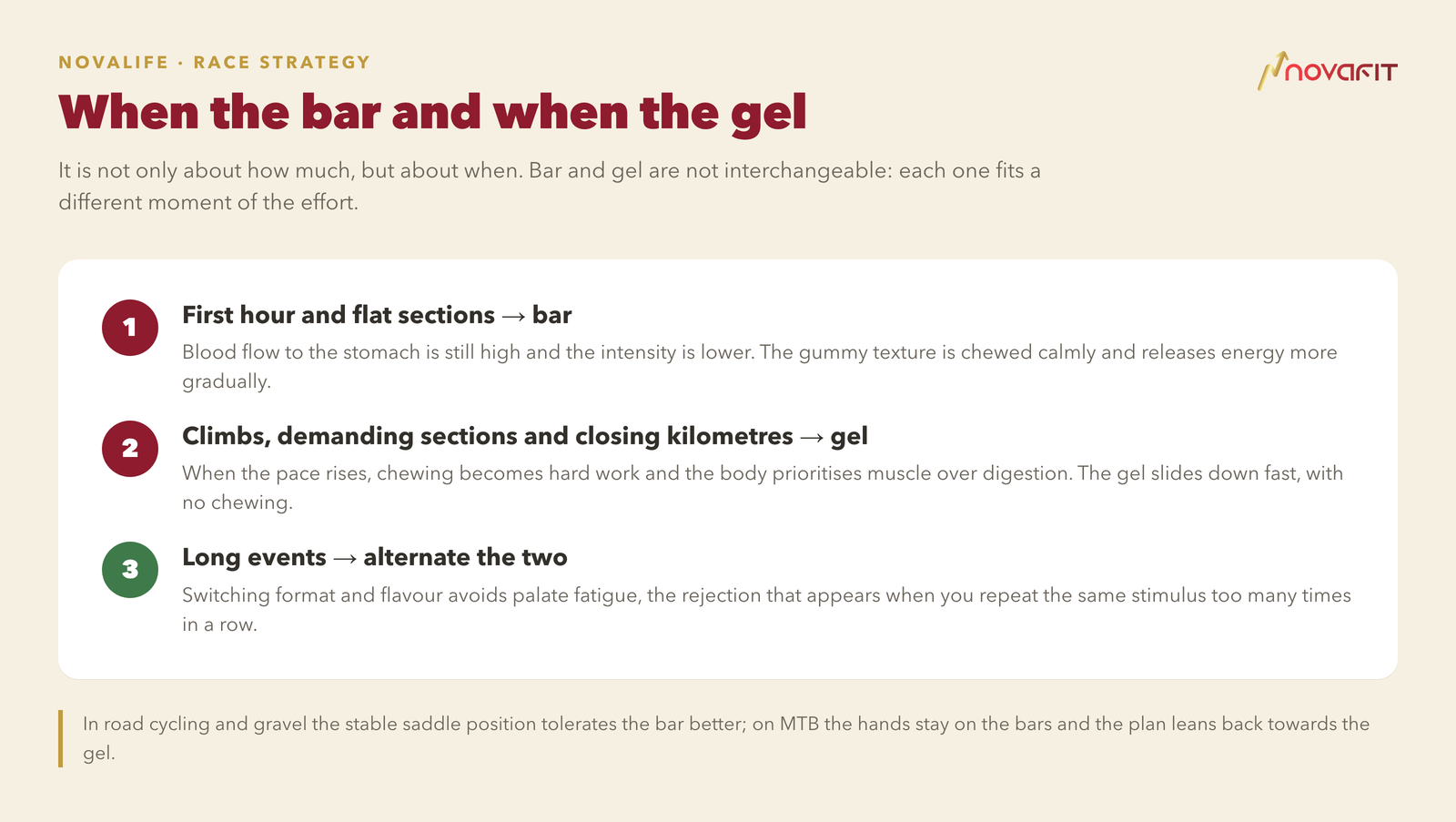
It is not only about how much, but about when. Bars and gels are not interchangeable — each one fits better at a different moment of the effort.
- First hour and flat sections → bar. Blood flow to the stomach is still high and the intensity is usually lower at the start of the event. This is the best moment for the bar: its gummy texture is chewed calmly and delivers a more gradual release of energy.
- Demanding sections, climbs or closing kilometres → gel. When the pace rises or a climb arrives, chewing becomes hard work and the body prioritises muscle over digestion. The gel slides down fast, with no need to chew, and is the safest option at the moment of greatest demand.
- On long events, alternating format helps you keep eating. Alternating format and flavour avoids palate fatigue, that is, the rejection that appears when you repeat the same stimulus too many times in a row. Switching from bar to gel (or changing flavour) is not only a digestive strategy, it is a sensory one too.
4. Hydration and sodium: the pairing missing from most calculators
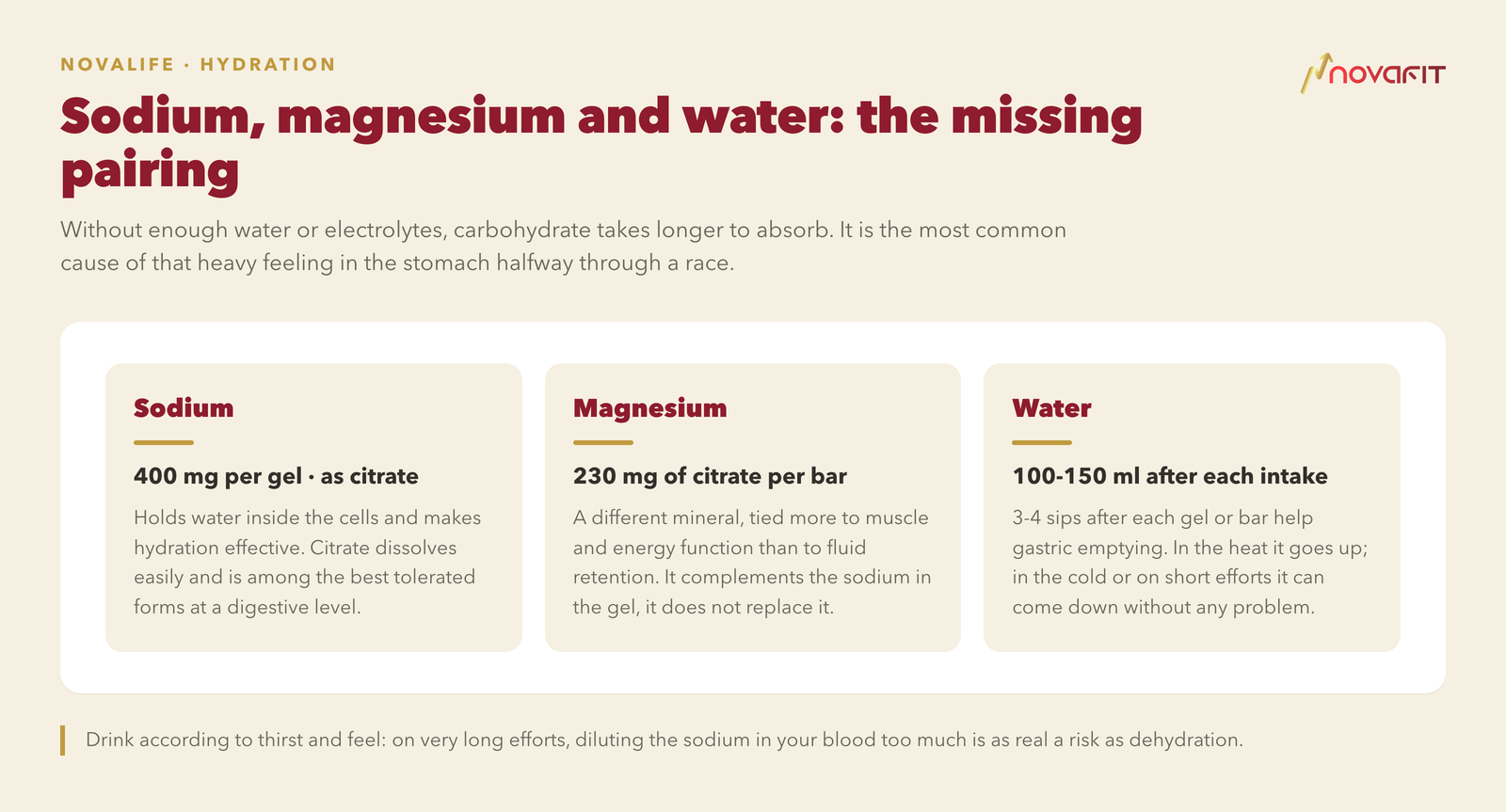
Almost no "how many gels do you need" guide talks about what happens once the carbohydrate is already in the stomach. And it is a key piece: without enough water or electrolytes, that carbohydrate takes longer to absorb, and it is the most common cause of that "heavy" feeling in the stomach halfway through a race.
Why sodium matters as much as carbohydrate
During prolonged effort the body loses sodium through sweat, and it is not only a question of cramps (the relationship between sodium and cramps is more debated than it seems), but of fluid balance: sodium is what holds water inside the cells and helps hydration to be effective, instead of "urinating away" the water you drink without making use of it.
Each NOVAFIT gel provides 400 mg of sodium in citrate form. Citrate, compared with other forms of sodium, dissolves easily and is one of the best tolerated forms at a digestive level, which helps the sodium reach the body quickly without adding extra gastric load at a moment when the stomach already has plenty of work.
- Each bar provides 230 mg of magnesium: a different mineral, with a role tied more to muscle and energy function than to fluid retention, and one that complements (does not replace) the sodium in the gel.
- That is why combining gel and bar throughout the race is not only a decision about texture or timing: it also spreads the electrolyte profile naturally between sodium and magnesium.
How much water to take with each intake
There is no single figure valid for everyone: it depends on the temperature, your sweat rate and how much you personally sweat; but there is one principle that holds almost always: taking a few sips of water right after each gel or bar helps gastric emptying and gets the carbohydrate into the blood sooner, instead of leaving it "stuck" in the stomach.
- There is no need to drink half a bottle in one go: 3-4 sips (roughly 100-150 ml) after each intake is usually enough to ease it through.
- In very hot conditions or with high sweating, that volume of water should go up; in cold conditions or short efforts, it can come down without any problem.
- Drink according to thirst and feel, not out of obligation: over-hydrating and diluting the sodium in your blood too much is, on very long efforts, as real a risk as dehydration.
Practical rule: if your race lasts more than 2-3 hours or it is hot, do not think only about how many gels or bars to carry; think also about how much water you will have available on each section. The 400 mg of sodium in the gel are there to help you retain that water, not to replace it.
Frequently Asked Questions
1. Can I apply this calculator to both running and cycling?
Yes. The calculator already includes specific terrain for road cycling, gravel and MTB, as well as road, mountain and high mountain for runners. The formula of grams of carbohydrate per hour is the same for everyone; what changes is the split between gel and bar: on road and gravel, with the stable position of the saddle, the bar is usually tolerated better even on medium-intensity sections; on MTB, technique rules and your hands are almost always on the bars, so the split leans back towards the gel; in running, the gel also gains weight earlier because of the mechanical impact of the stride.
2. What happens if I overdo it or fall short of the calculated amount?
Taking less than you need is the most common cause of hitting "the wall" in the second half of a race. Taking more, without having trained for it beforehand, is the most common cause of digestive discomfort. That is why this calculator is a starting point for practising in training, not a figure to improvise with on race day.
3. Do electrolytes prevent muscle cramps?
It is a more debated relationship than it seems: studies do not find a single cause for cramps, and factors such as muscle fatigue or a pace held for a long time also carry weight. What is clear is that maintaining a good sodium intake helps overall fluid balance, and that does influence how you feel in the closing hours of a race; all the more reason not to leave hydration in second place behind carbohydrate.
Bibliography and Scientific References
- Jeukendrup, A. (2014). A Step Towards Personalized Sports Nutrition: Carbohydrate Intake During Exercise. Sports Medicine, 44(Suppl 1), 25-33.
- Jeukendrup, A. E., & Moseley, L. (2008). Multiple transportable carbohydrates enhance gastric emptying and fluid delivery. Scandinavian Journal of Medicine & Science in Sports.
- de Oliveira, E. P., Burini, R. C., & Jeukendrup, A. (2014). Gastrointestinal complaints during exercise: prevalence, etiology, and nutritional recommendations. Sports Medicine, 44(Suppl 1), 79-85.
- Sawka, M. N., et al. (2007). American College of Sports Medicine position stand: Exercise and fluid replacement. Medicine & Science in Sports & Exercise, 39(2), 377-390.
- Schwellnus, M. P., Nicol, J., Laubscher, R., & Noakes, T. D. (2004). Serum electrolyte concentrations and hydration status are not associated with exercise associated muscle cramping (EAMC) in distance runners. British Journal of Sports Medicine, 38(4), 488-492.
Article written by the Novafit team.
Novafit: the energy you need, with the taste you deserve.