NOVAFIT ENERGY · Performance · Nutrition · Science
An honest analysis of what happens inside the athlete's body during prolonged effort — and how every NovaFit Energy formulation decision answers a real physiological need.
There is a question that keeps coming up in the sports nutrition world and that rarely gets an honest answer: what exactly is in there, and why?
Most brands on the market answer that question with marketing. They talk about performance, energy, recovery. They show athletes with sculpted bodies and stopwatches marking records. But when you open the label and read it calmly, what you find is a list of ingredients that does not always respond to the athlete's biology — but to the economics of the manufacturer.
At NovaFit Energy we do not start from what is cheap to produce. We start from a different question: what does the human body need when it has been running or pedaling for three hours, and what is the most effective way to give it? This article is the answer to that question. Without euphemisms, without empty promises.
1. What happens in the body when the effort drags on
To understand why a formulation matters, you first have to understand what is going on physiologically during endurance exercise. Not in the warm-up or at kilometer 10 — but at kilometer 50, in hour three of a long ride, in the second lap of a backyard ultra.
The fuels run out
The body stores glycogen — the form it uses to store glucose — mainly in muscle and liver. Together, those reserves represent between 400 and 600 g of glycogen, enough energy for approximately 90 minutes of intense effort. Beyond that point, if carbohydrate is not replenished, performance falls sharply. It is what cyclists call "the bonk" and runners "the wall": it is not a mental limit, it is a biochemical one.
The gut goes into stress
During intense exercise, blood flow is redistributed: active muscles claim between 80 and 85% of cardiac output. The digestive system is left in a state of hypoperfusion — it receives less blood, it works at reduced capacity. The result is a digestive system that during effort can absorb nutrients, yes, but is much more sensitive to irritants, artificial ingredients and low-quality nutrient forms.
That explains why some athletes tolerate a gel perfectly in a 45-minute training session and throw it up at kilometer 60 of an ultra. The ingredients did not change. The physiological state in which they were consumed did.
Electrolytes are lost through sweat
Sweat is not just water. It is water, sodium, chloride, potassium and magnesium, among other minerals. An athlete can lose between 1 and 2.5 liters of sweat per hour depending on intensity and environmental conditions. For each liter of sweat, between 500 and 1,500 mg of sodium and between 4 and 8 mg of magnesium leave the body. If they are not replenished, neuromuscular transmission deteriorates, muscle contraction loses efficiency and cramps appear.
Mental fatigue amplifies everything above
Beyond two or three hours of effort, fatigue is not only muscular. The accumulation of serotonin and other metabolites in the central nervous system contributes to central fatigue: the feeling that the body could go on, but the mind starts asking it to stop. And here the stomach plays an unexpected role: when the digestive system generates discomfort — nausea, bloating, intestinal urgency — perceived effort spikes and the ability to keep going is compromised long before the muscle has had its last word.
The stomach is not an accessory to performance. It is part of performance. What does not get absorbed does not help. What irritates, slows you down.
2. The energy architecture: five sources, one ratio, zero spikes
The problem with most energy gels on the market is not that they fail to deliver carbohydrates. It is that they deliver them inefficiently — and sometimes in a way that creates more problems than it solves.
When a gel is based almost exclusively on maltodextrin or simple glucose, intestinal absorption has a ceiling: the SGLT-1 transporter, responsible for absorbing glucose, saturates above approximately 60 g of carbohydrate per hour. Above that threshold, the excess carbohydrate stays in the intestine, generates osmotic pressure and can produce exactly what no athlete wants: diarrhea, abdominal bloating or nausea mid-race.
The solution has been in the scientific literature for years. NovaFit Energy gels apply it rigorously:
1:0.8 glucose:fructose ratio — the dual transporter
The small intestine has a second specific transporter for fructose: GLUT-5. When glucose and fructose are combined in the right proportion, both transporters work in parallel and total absorption capacity rises to more than 90 g of CHO per hour without increasing the risk of gastrointestinal discomfort. It is the same principle applied by the nutrition protocols of professional cycling teams and elite ultra-endurance athletes.
Our gels combine five carbohydrate sources — Golden Sugar, glucose syrup, fructose syrup, maltodextrin and isomaltulose (Palatinose) — in that optimized ratio. Each source has a different absorption profile: some act in the first few minutes, others from 30 minutes on, others over hours. The result is an energy curve with no spikes or valleys, that arrives immediately, holds during effort and extends over time.
Isomaltulose deserves a special mention. Unlike simple sugars, its intestinal absorption is slow and progressive, stabilizing the glycemic response and avoiding the hypoglycemic rebound that any athlete who has taken a sugary gel knows so well — and felt, twenty minutes later, that empty feeling that forces them to eat again urgently.
The five CHO sources of NovaFit Energy work in cascade: energy in the first minute, energy at 20 minutes, energy at 45 minutes. The curve the endurance athlete needs — not the one that is cheapest to produce.
3. Sodium: the hydration that water alone cannot deliver
Drinking water during exercise is necessary but not sufficient. Without sodium, water is not retained in the plasma compartment — the body excretes it quickly through urine and sweat, before it can fulfill its role of maintaining blood volume.
Sodium acts as the gatekeeper of hydration. Its presence in the bloodstream pulls water with it, maintains plasma volume and ensures that nutrients — including the carbohydrates of the gel itself — reach the muscle efficiently. Without enough sodium, neuromuscular transmission deteriorates and cramps are not far behind.
NovaFit Energy gels deliver 400 mg of sodium as sodium citrate per unit — the highest reference dose on the market for a 70 g gel. Some competitors reduce the sodium to improve the flavor profile. We keep it because function comes before flavor. The athlete who has been sweating for hours does not need a gel that is pleasant on the palate at the expense of their most critical electrolyte. And the proof is in the result: despite the 400 mg of sodium, the fruit flavor of NovaFit Energy gels remains powerful, clean and recognizable. Real fruit does that work — something no artificial aroma can match at this dose.
4. Magnesium bisglycinate: the difference the muscle feels
We already dedicated a full article to magnesium bisglycinate and why the form of magnesium matters as much as the dose. But in the broader context of performance, it is worth summarizing the key: not all the magnesium you ingest reaches the muscle cells.
Magnesium oxide — the most common form in cheap supplementation — has a bioavailability of between 4 and 15% under normal conditions. Under intense effort, with reduced intestinal blood flow and altered gastric pH, that figure can be even lower. Magnesium bisglycinate, by contrast, being chelated with glycine, is absorbed through the amino-acid transporters of the small intestine — a direct pathway, independent of pH and up to five times more efficient.
NovaFit Energy gels provide 125 mg of bisglycinate. An amount that reaches the muscle when it is needed: reducing the likelihood of cramps, sustaining ATP synthesis and contributing to maintaining the efficiency of muscle contraction in the final stretches — where, invariably, races are decided.
5. Real fruit as a technical decision, not a marketing decision
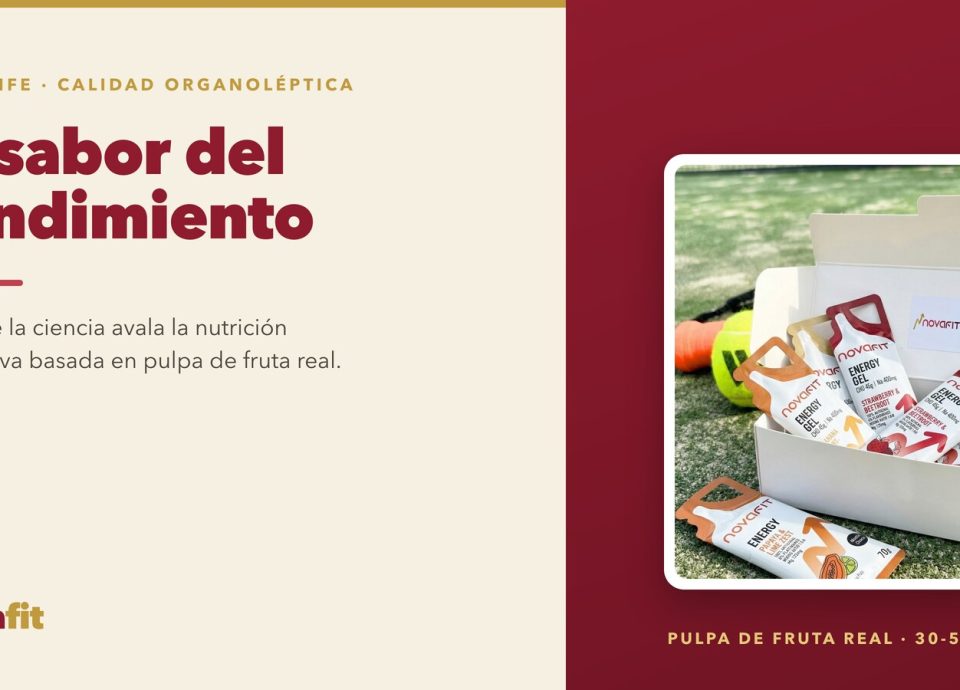
When we say our gels contain 30% natural fruit pulp, we do not say it to look good on the label. We say it because it is the consequence of a technical conviction we have been applying for more than twelve years in our workshop.
Palatability in prolonged effort is a performance factor
Beyond two or three hours of effort, sensory fatigue is a real problem. Artificial flavors — sweet, intense, invariably synthetic — start to generate rejection. The athlete who has spent hours consuming conventional gels reaches a point where their body, literally, does not want any more. And without carbohydrate intake, performance falls.
Real fruit has a completely different sensory profile: clean, fresh, recognizable. It does not become cloying because it is not artificial. The brain processes it as food, not as a chemical product. And that difference — which seems minor at 9 a.m. in front of the shop window — becomes decisive at 3 p.m., at kilometer 70, when the stomach is already rejecting anything that smells synthetic.
The digestibility of fruit is a physiological advantage
The cells of the small intestine have spent thousands of years learning to process fruit. Its natural matrix — soluble fiber, water, micronutrients, bioactive compounds — supports the work of the intestine even under digestive stress. Artificial additives, by contrast, are substances the intestine does not always recognize easily, and whose presence can contribute to irritating the intestinal mucosa during intense effort.
This is not a philosophical argument. It is applied physiology.
The micronutrients nobody adds — because they are already there
Fruit provides potassium naturally. It provides antioxidants that help counter the oxidative stress generated by intense exercise. It provides structural water that facilitates the absorption of carbohydrates. And it does so without us having to add them as separate ingredients, without them appearing on the label as marketing claims, simply because fruit contains them.
We use real fruit because it is the best thing we can put in there. Not because it is the easiest thing to communicate — but because it is the hardest to manufacture.
6. NovaFit Energy versus the market: an honest comparison
We are not going to claim we are the only ones doing things right. There are brands on the market that work with serious quality criteria and that have made significant progress in recent years. What we can affirm, after analyzing the Spanish and international market, is that there is to date no other gel that combines 100% artisan production, a minimum of 30% natural fruit pulp, magnesium bisglycinate, five carbohydrate sources in a 1:0.8 ratio and 400 mg of sodium as sodium citrate — with not a single added flavoring, no colorants, and suitable for everyone: vegan, gluten-free and lactose-free. All in a single product.
| Criterion | NovaFit Energy | Reference market gels | Conventional bars |
|—|—|—|—|
| CHO source | 5 sources — 1:0.8 ratio | Maltodextrin + glucose | Simple sugars + starch |
| Magnesium | 125 mg bisglycinate | Absent or minimal | Variable / oxide (low absorption) |
| Sodium | 400 mg sodium citrate | Variable (often reduced) | Low or absent |
| Product base | 30% real fruit pulp | Water + thickeners + flavors | Cereals + syrups |
| Digestibility in effort | High — no irritants | Variable — risk of discomfort | Moderate |
| Flavors / colorants | None — real fruit | Common | Frequent |
| Gluten-free · vegan | Yes, always | Variable | Variable |
| Production | Artisan — small batches | Mass industrial | Mass industrial |
Green: clear advantage · Amber: depends on the product · Red: common disadvantage
7. What the real athlete experiences
Physiology is the foundation. But the definitive test is the one that happens out on the ground — in the race, in the long training session, at the kilometer where the body lays its cards on the table.
These are the patterns we have consistently observed among athletes who have incorporated NovaFit Energy into their nutrition:
Lower incidence of digestive discomfort even in efforts of more than four hours. The combination of real fruit, bisglycinate and the absence of artificial additives produces a gel the intestine handles easily even when digestive blood flow is compromised.
Reduced appearance of cramps in prolonged efforts. Magnesium bisglycinate reaches the muscle. It does not stay locked in an intestine unable to absorb inorganic forms under physiological stress.
Absence of "flavor fatigue" even when taking several gels in a row. The sensory profile of real fruit does not generate the rejection produced by the repeated intake of artificial aromas.
Sustained energy without spikes or valleys thanks to the five CHO sources in an optimized ratio. The typical pattern of the athlete who takes a simple-glucose gel — sharp rise followed by sharp fall — does not occur with the NovaFit Energy architecture.
Greater ease in sticking to the nutritional plan in long races. When the gel does not generate rejection and digestion does not become a problem, the athlete can keep ingesting carbohydrate according to plan — and that, translated into performance, has a direct impact on the result.
A conclusion that does not need ornaments
Sports performance is the sum of many correct decisions taken over weeks, months and years of training. But on race day, at the moment when the body demands what you promised it, nutrition is not an accessory — it is infrastructure.
NovaFit Energy is not the cheapest product on the market. It does not aim to be. It is the product where every formulation decision has a physiological reason behind it, where the quality of the ingredient is not negotiated when it raises the cost of production, and where the only criterion guiding development is what the athlete's body actually needs.
At kilometer 80 of an ultra-trail, on the final climb of a long ride, on the last lap of a backyard ultra: the body knows how to tell the difference between what you have given it and what it needed.
We make sure they are the same thing.
NovaFit Energy — novafitenergy.com — @novafitenergy
Sant Feliu de Llobregat, Barcelona · Artisans of performance for twelve years
Related articles
- Kilometer 60: What Really Happens to the Body in the Second Half of an Ultra-Trail
- Why Race Nutrition Fails: The Mistakes Nobody Tells You About
- The Hypoglycemic Rebound: The Silent Enemy That Wrecks Your Race in the Final Kilometers
- Magnesium in Energy Gels: Why the Form Matters as Much as the Dose
- Three Gels, Three Fruits, One Formula: The Science Behind NovaFit Energy Gels
- NovaFit Energy Gel: Artisan Energy Made From Real Fruit